

LENZ Therapeutics sells one product, VIZZ, a once-daily aceclidine eye drop for presbyopia, the age-related loss of near vision. It is FDA approved, fully cash-pay at about 67 dollars of net revenue per pack, and sold through national television, telehealth and an ePharmacy. At the end of June the company had about 220 million dollars of cash and securities, 31.4 million shares and no debt (Q2 2026 10-Q). That works out to roughly 7 dollars a share of cash, and most of the bull case I have seen rests on that number.
I do not think the cash is the right place to start. The money is being spent, at a rate of more than a dollar a share per quarter, to find out whether VIZZ is a business. What I care about is who gets to stop the spending, when, and what is left at that point.
What VIZZ has to prove
I see four conditions VIZZ needs to meet.
No serious safety event. Aceclidine is a miotic, and the class has a known tail risk of retinal events. The real-world data so far is clean, though the retinal risk remains.
Demand has to grow much faster than it has. Pack volume went from about 23.5 thousand in Q4 to about 25 thousand in Q1 to about 27 thousand in Q2 (Q2 results release), single-digit growth per quarter. For the product to work as a business I think it needs something like 50 thousand packs a quarter, sustained, which is an 85 percent step from here.
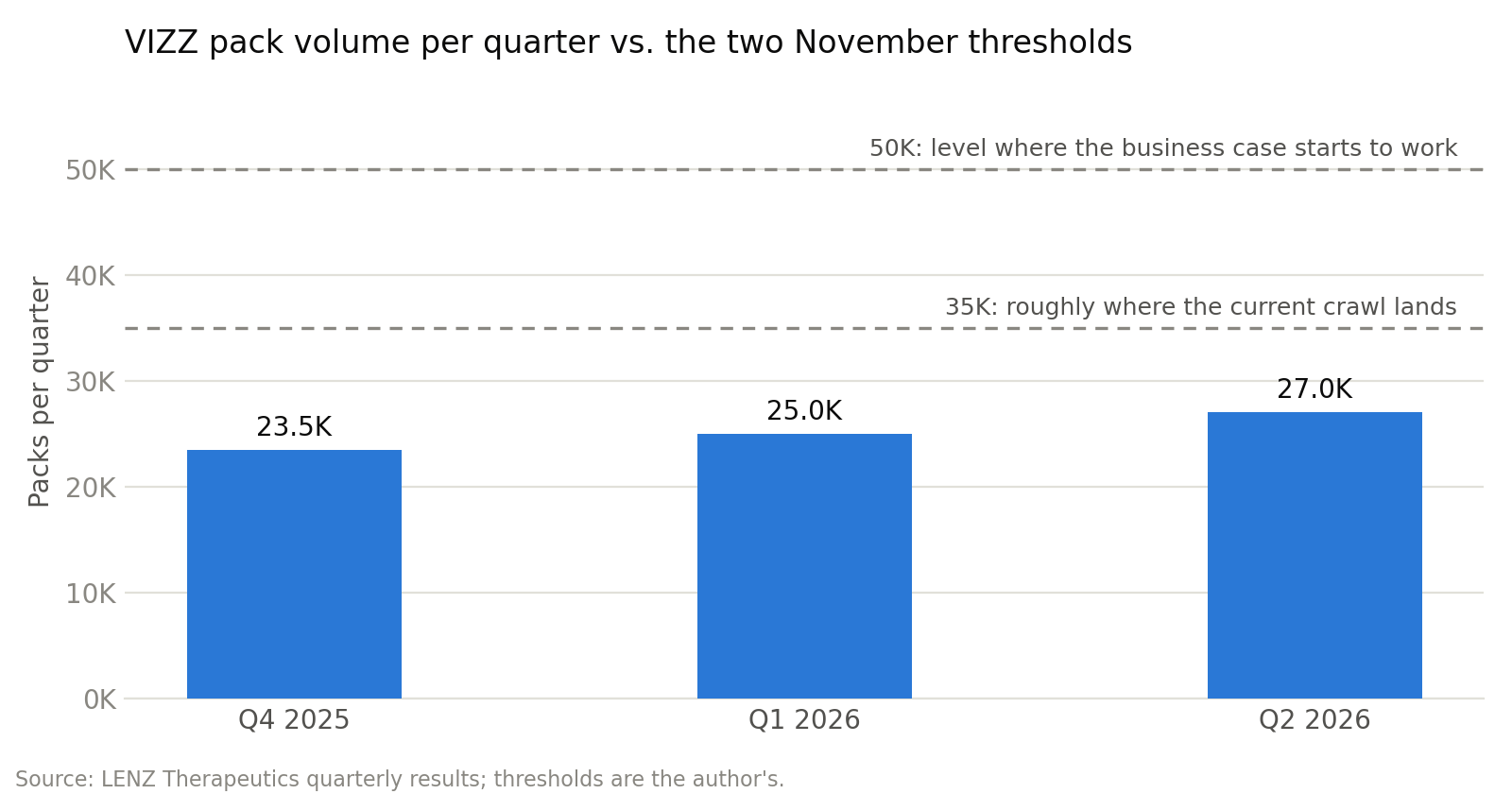
VIZZ pack volume per quarter, from company results, against the two thresholds I use in November.
If demand shows up, the unit economics have to work. My estimate of a patient’s lifetime value is 150 to 300 dollars. Advertising alone costs about 1,100 dollars per new patient, and fully loaded sales and marketing is closer to 2,700. That is a ratio of roughly 0.15 to 0.4. Scale helps, because television is largely a fixed cost and the organic share should rise, and I can see a three to five times improvement from that. It still lands below one. Getting to a ratio of two or three needs customer acquisition cost to fall by an order of magnitude, which only happens if patients start recruiting other patients. The terms of the first financing will determine how much of the upside current shareholders retain, and that is the fourth condition.
Demand and retention: what the new data says
The first real retention number with a patient denominator came from a single-center prospective study presented at ESCRS: 61 patients, average age 57, followed for three months. Nine were still using the drop at three months, which is 14.8 percent. About 40 percent reported bothersome side effects, mainly dim vision and headache, which come from the pharmacology rather than from anything fixable in packaging or pricing. There were no serious ocular adverse events. The company’s 42 percent repurchase figure and its “five boxes a year” are model outputs from an auto-refill ePharmacy, not cohort observations, and a measured 14.8 percent is far below the 40 to 50 percent three-month refill rate a consumer health product needs. In August I had the unit-economics gate at 43 percent. This reading is why it is now at 30.
Search interest says the advertising works and the organic base does not exist yet. Google Trends for “VIZZ eye drops” shows four waves since July, each peaking higher than the last, with the week of October 11 the highest since launch, and the index falls back to zero between waves.
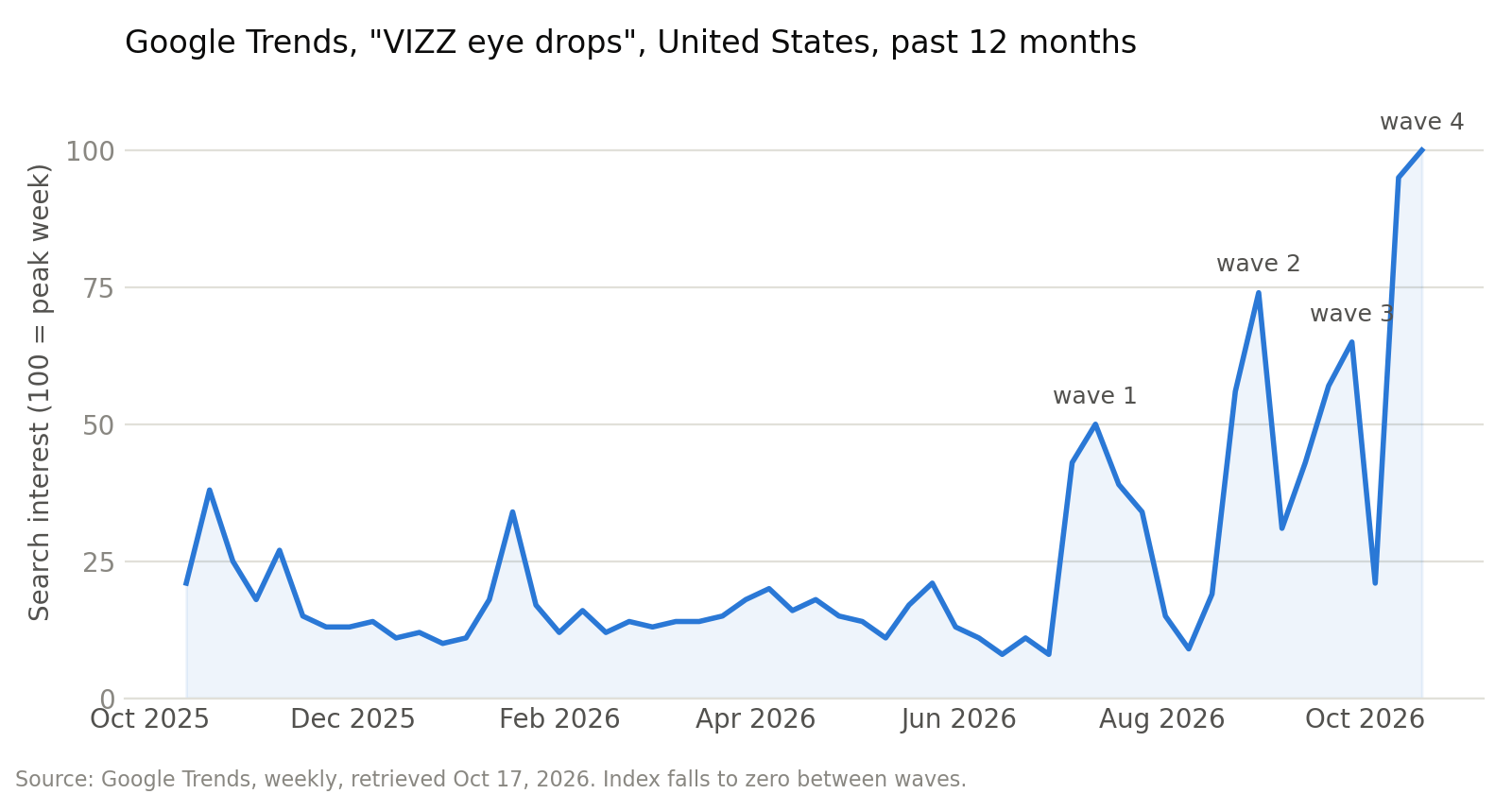
Weekly Google Trends index for “VIZZ eye drops” in the United States over the past 12 months. Four advertising waves, each higher than the last, and the index falls back toward zero between them.
Management’s response has been to spend more. Calibrating the Trends area against reported Q1 and Q2 ad spend gives an estimated 25 million dollars of Q3 advertising, with a range of 20 to 35 million. The fourth wave began in mid-October and is still running. Independent television tracking counted just under three thousand national airings in the thirty days to October 17. Management is increasing advertising as the Q3 report approaches.
Cash burn and management incentives
Cash is 220 million. Burn excluding advertising runs about 35 million a quarter. With advertising at 30 million a quarter the all-in burn is around 54 million, which takes cash to roughly 63 million by the end of the first quarter of 2027. The at-the-market program is used up. In the second quarter the company stopped saying that cash would carry it to profitability. The RA Capital partner left the board at the end of June, so RA’s 13 percent stake, unchanged so far, no longer comes with a seat. Fidelity has gone from 15 percent to under 6 percent (13G/A). Lease liabilities are under a million dollars and ad contracts can be stopped month to month, so stopping quickly is possible. Nothing in the record suggests it is being considered.
Each additional quarter of spending at this rate reduces the value of the failure case by about a dollar a share, which makes the timing of any stop a bigger input to this valuation than the size of the ad budget.
Valuation
Combining my probabilities for safety, demand, unit economics and dilution puts the chance of commercial success at a little under 8 percent. In that case I value the shares in the mid-teens: 2028 revenue of 130 to 180 million, a sales multiple of about three times, and about 25 percent dilution between here and there. These are my estimates, and the revenue number assumes close to 190 thousand paying patients against fewer than 20 thousand active today.
The failure case splits three ways, and the weights are my judgment. A quick stop, where management cuts spending after the Q3 report and sells or winds the company down by mid-2027, would leave about 3 dollars a share. I give it 10 percent, because the people who could do it have shown no sign of wanting to, even though the CEO has sold a company before. A slow grind, where results land in the middle, management keeps watching one more quarter, and cash runs down to a forced decision, gets 50 percent and is worth about 2.5 dollars on my current assumptions, with a real chance it ends closer to 1. A bad outcome, mostly a cheap financing or a reverse merger that leaves current holders with a fraction, gets 40 percent, up from 30 in August, because the shorter cash runway makes a financing before the Q1 2027 report hard to avoid; that path is worth about a dollar.
Weighted, the failure case is worth about 2 dollars a share. Including the success case brings expected value to about 3 dollars, with a range of 2.2 to 3.5. In July my number was 6.4 and in August it was 3.9. The drop from 3.9 to 3 is almost entirely the ESCRS retention reading and the decision to put more weight on the bad outcome.
I estimated this before checking the share price. LENZ trades in the mid-3s, having fallen through the level where I had an alert set. At that price the stock sits close to my expected value, and I do not see a margin of safety in either direction. I would not treat the 7 dollars of cash as a valuation floor while management continues spending.
Buying here is a bet on the third-quarter report in mid-November delivering two things at once: a step up in pack volume toward 50 thousand, and a retention curve with a patient denominator attached. If only one of them shows up, the company can keep spending without a viable business underneath it.
What I am watching in November
The two items that can change my number are retention and volume. On retention I want a patient denominator and a cohort curve; another quarter of the 42 percent model figure tells me nothing new. On volume, 50 thousand packs is the level where the business case starts to work, and 35 thousand is roughly where the current single-digit crawl would land, so a print above the first makes me raise the demand probability and a print below the second makes me cut it. Anything in between keeps me waiting for the next quarter.
The rest is confirmation. Reported Q3 advertising at or above 25 million confirms the acceleration, and a figure well under 15 million means my search-based estimate was wrong and the quick-stop path deserves more weight; any comment on Q4 spend matters for the same reason. Financing: the terms of any raise will change my dilution assumptions. And, as always for this class, anything from FAERS or a label change.
Disclaimer: This is not investment advice. I may hold positions in securities discussed and may change them at any time without notice. All figures are from company filings, public data sources and my own estimates, which may be wrong. Do your own work.