

In July I wrote up BellRing Brands with five scenarios and an expected value of about $16 a share, against a stock then in the low teens. I set myself a line at $8.10, half of that number, as the point where I would have to go back and redo the work rather than keep watching. The stock went through it in mid October.
Two things changed between then and now. The company cut its fiscal 2026 EBITDA guidance a third time, to a midpoint of $285 million, which is 35% below the $440 million it first guided to last November. And I changed the method. The July piece valued the business from the top down: take a historical 20% margin, subtract a few points for private label and advertising, and call the result mid-cycle. That gave me no way to say what a price increase or a promotion was actually worth.
The unit economics of one bottle
Premier Protein is about 85% of BellRing’s sales, and the 11 ounce ready-to-drink shake is roughly four fifths of the company. BellRing owns the brand and the formula; co-packers make the product. There is one owned plant, in Germany, which makes bars and gels for Europe, and that is the entire manufacturing footprint. Capital spending has run between 0.1% and 0.6% of sales for nine years (fiscal 2025 10-K).
So almost every cost is a cost per bottle. My reconstruction for fiscal 2026 is about $1.47 of net price per bottle, $1.08 of cost (milk protein, the bottle and packaging, the co-packer’s fee, freight, tariffs), and $0.39 of gross profit. The company does not disclose price per bottle. I backed it out from reported sales and volume, and the same method lands within three tenths of a point of reported gross margin for the last two fiscal years, so I trust the shape even if the third decimal is off.
Gross profit is 27% of price. Raise the net price 10% and gross profit per bottle rises 38%; the company could lose 27% of its volume before total gross profit fell. Cut the net price 10% and it needs to sell 60% more bottles to stand still. In this calculation, volume matters less than net price and the cost of milk protein.
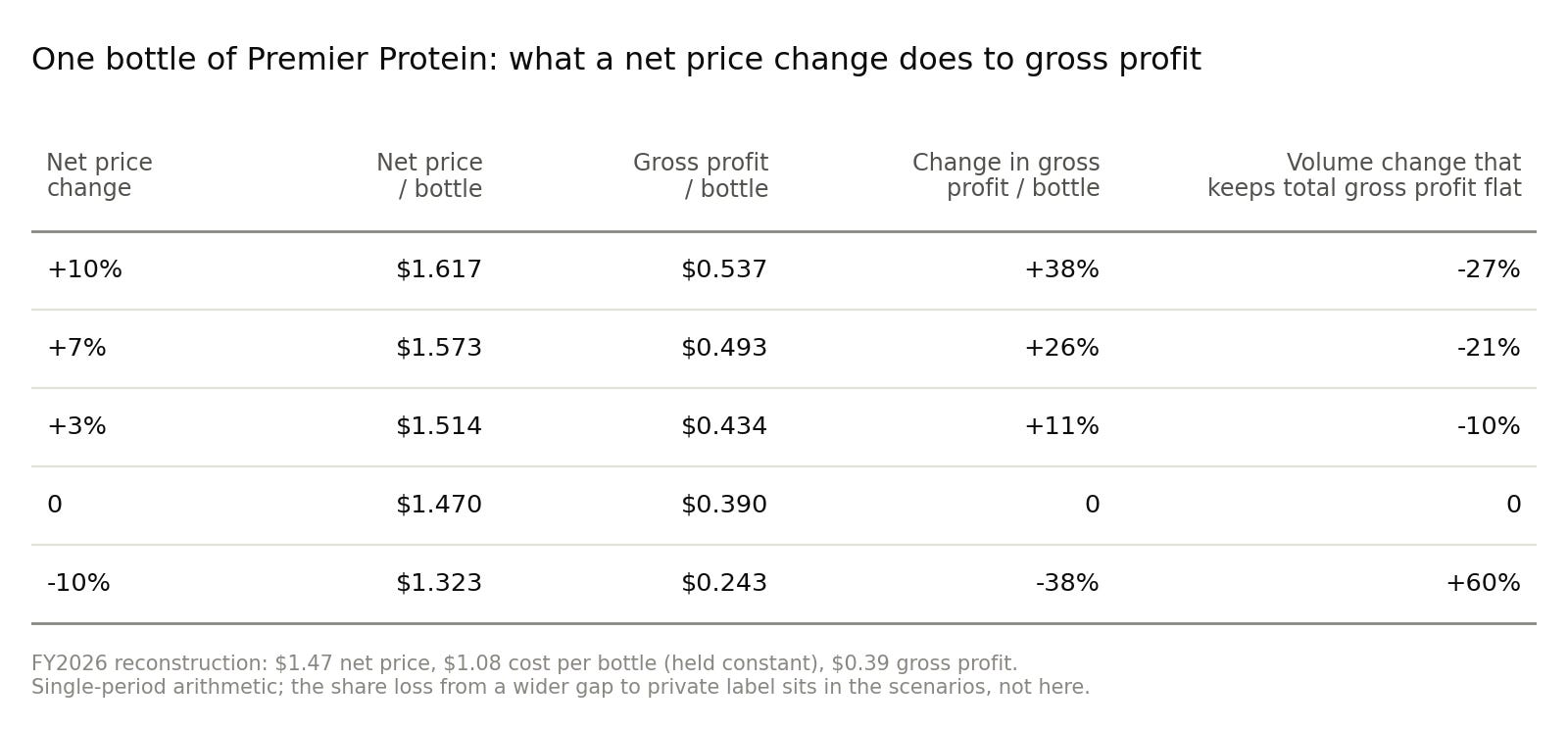
Net price per bottle, gross profit per bottle and the volume change that would leave total gross profit unchanged, from my fiscal 2026 reconstruction ($1.47 price, $1.08 cost held constant). A 10% increase lifts gross profit per bottle 38% and can absorb a 27% volume loss; a 10% cut needs 60% more volume.
In fiscal 2026, lower price/mix outweighed volume growth. In the March quarter, shake volume grew 11.7% and price/mix fell 9.4%. Adjusted gross profit dropped 27%, and that is after setting aside an $11 million ingredient write-off. Management said the promotions ran as planned.
One caveat on the arithmetic: it covers a single period. Raising the list price widens the gap to Kirkland and the other store brands, and that costs share over the following two years. I handle that inside the scenarios rather than inside the per-bottle math.
Pricing and inventory
Adjusted EBITDA margin, on the company’s own definition, ran between 16.6% and 23.2% in the nine fiscal years from 2017 to 2025, with seven of the nine at 18% or above. The fiscal 2026 guidance midpoint works out to about 12%. I do not know whether that 12% is temporary or lasting, and most of what follows is an attempt to say what each answer would be worth.
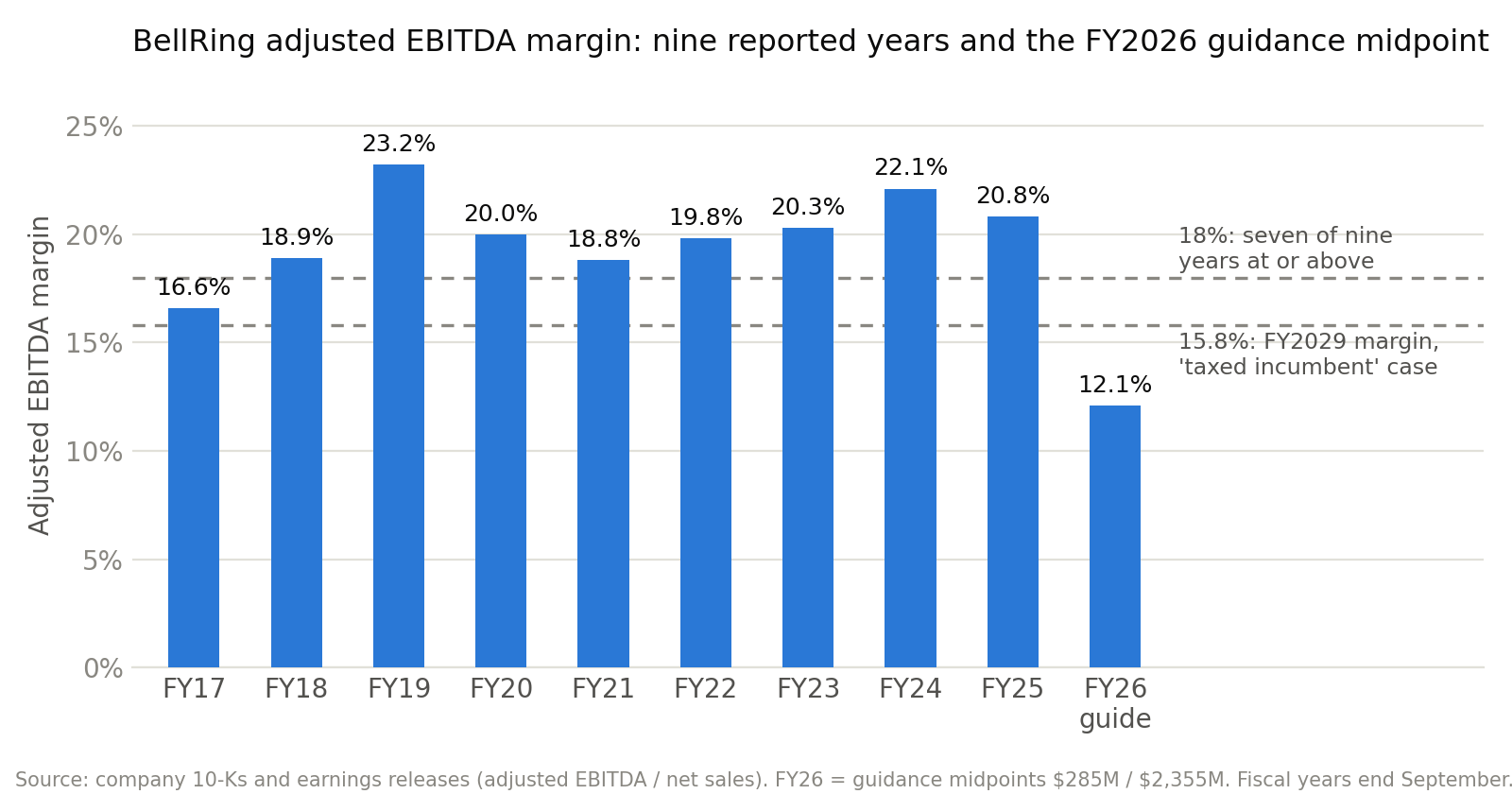
Adjusted EBITDA divided by net sales, from the company’s 10-K filings and earnings releases; FY2026 uses the $285 million and $2,355 million guidance midpoints. Data through October 19, 2026. Seven of nine reported years sit at or above the 18% line; the guidance bar is the first reading below 16%.
On the August 4 call, the chief financial officer said the company will take a double-digit list price increase on Premier shakes in the first quarter of fiscal 2027, that retailer negotiations were close to complete, and that another major ready-to-drink player had raised prices by double digits earlier in the year. On the same call he said the fourth quarter would carry heavier promotion to clear bottle inventory. Finished goods inventory was $410 million at June 30 against $242 million at the September 2025 year end, up 69% while sales grew 2%.
The last list price increase, in the fall of 2024, was handed back through promotion within four quarters. And the explanation for the inventory has changed each time it has been given: “largely normalized” in February 2025, e-commerce load-in timing in August 2025, a third-party ingredient problem in May 2026, and in August 2026 the carton format cannibalizing bottles faster than planned. The filings do not split bottles from cartons, so none of this can be checked from outside, and I give the attributions no weight in either direction. The new chief executive, Mike Axelrod, was a week into the job on that call. He said the company had not executed at the level it expects of itself and declined to put a number on where margins settle. Both of those moved me a little: the explanation was internal rather than external, and there was no margin promise of the kind the previous team kept making and missing.
Debt and other claims
Before shareholders get anything there is $840 million of 7% notes due 2030, $300 million drawn on the revolver (undrawn at the start of 2025), stock compensation that I capitalize at about $220 million, and a securities class action I reserve $25 million for. Call it $1.4 billion of fixed claims. Depending on the scenario, that is anywhere from a third of operating value to more than all of it. The company bought back $595 million of stock between January 2025 and June 2026, part of it with revolver money, at average prices that ran from about $72 a share down to about $32. Those buybacks are why the equity sits this far behind the claims.
The model and six cases
I use a three-year model, fiscal 2027 through 2029, with a 10% discount rate, a 27% cash tax rate, and a terminal value of ten times fiscal 2029 free cash flow with no growth. Per-share value is operating value, less the $1.385 billion of claims, divided by 116.6 million shares. Fiscal 2029 EBITDA comes out of one equation:
EBITDA = bottles × [(1 − advertising rate) × net price per bottle − $1.145] − $98 million
The $1.145 is the fiscal 2029 cost per bottle: $1.11 of product cost plus about 3.5 cents of warehousing and broker fees that move with volume. The $98 million is the corporate overhead left uncovered by the powder and other businesses. Every scenario is a choice of bottles, price and advertising rate plugged into that line, and I use six. In the commoditized decline, the club channel breaks, inventory gets dumped, and operating value ends up below the claims. Stuck in the hole means the price increase mostly fails to stick, share loss eats the category’s growth, and margin stays near 12%. Volume instead of price is the company giving the increase back and chasing volume, as it did this spring. The taxed incumbent keeps the number one spot and about half the price increase, with margins permanently lower because of retailer pressure and private label. Full repair has share stabilizing by fiscal 2029, advertising back down to 3.2% of sales, and margin back at 18%. The bull case is margins near 20%, or a buyer paying 11 times forward EBITDA. The inputs for each case, and what each is worth per share, are in the table.
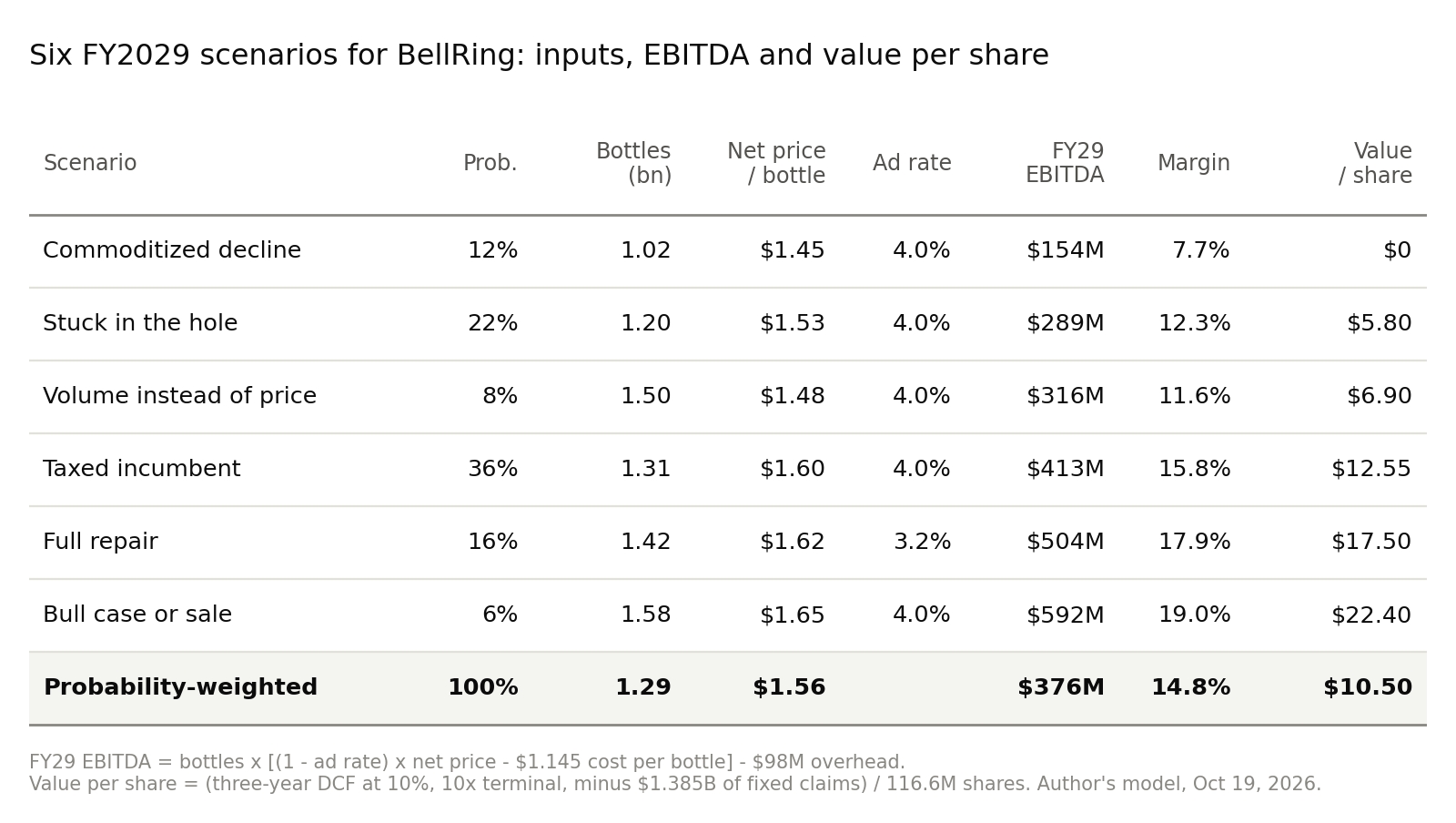
Inputs, fiscal 2029 EBITDA and value per share for each case, with the weight I give it. Per-share values run from $0 in the commoditized decline to $22.40 in the bull case; the bottom row is the probability-weighted result, $10.50. The equation and discounting are in the footnote.
The six weights were set first, scenario by scenario. Added up, the three cases in which the fiscal 2027 price increase nets out at 5% or better come to 58%, and that is the single number I would defend least confidently. If the increase holds, the most likely outcome is that Premier keeps its number one position with a permanently lower margin; if it does not, the margin stays near 12%. Weighting the six cases gives $10.50 a share. Moving ten points of probability from the 12% case to the lower-margin-incumbent case shifts the number by about 70 cents. Each $100 million of fiscal 2029 EBITDA is worth about $5.50 a share, and each point of margin about $1.40.
A first draft of this rebuild had a probability tree that contradicted its own scenarios. When I worked it backwards it assumed an 88% success rate on the price increase while the text said 55%; fixing it cost about 30 cents of expected value and is part of why the number above is what it is.
The stock trades around $9.40 as I write this on October 19, above the two failure cases and below the lower-margin-incumbent case.
November guidance and February results
In mid November, with the fiscal 2026 10-K, comes fiscal 2027 guidance. As rough reference bands from the model, guidance below $315 million of EBITDA would sit with the stuck-in-the-hole case, $315 to $345 million with the taxed incumbent, $345 to $366 million with full repair, and anything above that with the bull case. I will also look at whether fourth-quarter inventory actually came down, and whether the inventory story is the same one told in August.
In early February, the first quarter of fiscal 2027 will be the first full quarter at the new list price. Price/mix of +5% or better with volume down no more than 10% would support my view that the increase stuck. Price/mix of +3% or less would make me doubt it. Volume up more than 5% with flat or negative price/mix would tell me the company chose volume again.
The other inputs, milk protein prices, the tariff on imported milk protein concentrate (about 80 basis points of sales), what Kirkland does about lactose-free and flavors, the 2030 refinancing, matter less than the pricing, volume and inventory figures in those two disclosures.
In July I was valuing the brand. Changing the method, and the business getting worse in the meantime, took the center from $16 to $10.50. I cannot cleanly separate the two.
Disclaimer: This article is written for my own research and investment framework purposes only. It is not investment advice, a securities recommendation, or an offer to buy or sell any security. All valuation ranges, probabilities and scenarios are my own subjective judgments and may contain errors or omissions. I may hold positions in securities mentioned. Readers should verify company filings, financial data and market prices for themselves and make their own decisions based on their own risk tolerance and objectives.